Wednesday, 12 March 2014

Very Simple Concepts Day: Wifebeating is hilarious

Today is Very Simple Concepts Day, here at oldjawjaw towers. Today we are going to be discussing the concept of The Wifebeater.


You see, we call it a wifebeater because it is associated with men from the working classes, like domestic violence is! It's okay to call it that because we're being ironic, duh, and also because we don't think domestic violence is important or that survivors deserve respect. LOL!


Similarly, we call this The Old Wifebeater, because it is associated with men from the working classes, like domestic violence is - but with a fun new twist: not only is domestic violence inherently hilarious, but it is probably caused by booze, AKA the "beer made me do it, m'lud" defence.

Fun fact: I myself have drunk several pints of Stella in my time! I have worn many vests! I have even done both of these things at the same time - while not being rich, at that. And yet I have never beaten anyone's wife, nor committed violent assault on anyone I happened to be dating.

It's almost like being poor and drinking lager bear no relationship to one's propensity to perpetrate intimate partner violence whatsoever.

Thursday, 6 March 2014

STRIPPING IS BAD FOR WOMEN: FEMINISM CAN STOP NOW.

Good news, feminism! Remember the whole Feminist Sex Wars thing? When Dworkin, MacKinnon et al were all, "under the patriarchy, women are defined as the Sex Class, and therefore cannot give meaningful consent to intercourse; porn depicts and actually is violence against women; BDSM fetishizes power differentials and sex work is collusion with the patriarchy"? (Paraphrasing.)

And then other feminists were like, "Okay, porn is often sexist, because lots of media produced in a sexist society is sexist, and putting all the responsibility for patriarchy on porn seems to miss the point a bit; BDSM actually features a hell of a lot more negotiation and work around consent than vanilla sex; queer and feminist porn can and does exist; finding a feminist and non-oppressive way to inhabit our sexualities seems a valid way of resisting the patriarchy; sex work is only degrading in that all work under capitalism is degrading, and is demonising sex workers - you know, who include some of the most vulnerable women in society - really the best way to achieve a lovely feminist utopia?"

Again, paraphrasing. Turns out summarising one of the most contentious and complex debates over the last forty years of feminism and attempting to do justice to both 'sides' in two short paragraphs is actually pretty difficult!

Anyway: whatever your take on the matter, don't worry about it, because some random dude in The Times has SOLVED THE FEMINIST SEX WARS. Forever.

In response to a Leeds University study showing that nearly a third of all UK strippers are middle-class students, Kevin Maher has some opinions to share.

You may be wondering why Kevin Maher, who is neither a stripper or a student, feels that the world will not be able to rest easy until his very important opinions on the question of the place of sex work in society are known, but hold your horses: he has read some SCIENCE. Which proves, incontrovertibly, that stripping is

"bad for women. It's that simple."

Pictured: THE PATRIARCHY
Wowza. Thanks, Kevin! All this hoo-ha, and you had the answer all along! Thanks for bringing us to the light.

How does he know this? He knows this because
I simply look to the data in the groundbreaking 2003 Lilith report, which found that the number of rapes near lap-dancing clubs were three times the national average, or that in the years after the opening of a lap-dancing club in Tottenham Court Road, London, reports of female rape in the borough increased by 50 per cent.


Oh, Kevin. Kevin, Kevin, Kevin. Here I was, thinking that you had some amazing new data for me; a beautifully designed, value-neutral, empirically robust study which could settle this whole kerfuffle once and for all. But instead you just have... really bad science. Which you clearly read a press release on, rather than parsing the reports themselves. Which you clearly did not google before including them in your world-shakingly revelatory column, because, had you done so, you would have discovered this study does not show what you think it does.

So, the Lilith Report claimed that Camden, which had seven licensed strip clubs at the time, recorded three times the national average number of rapes between 1999 and 2002. It also claimed that the number of rapes increased by 50% between 1999 and 2002.

Which would be fairly solid proof that stripping IS BAD FOR WOMEN, except that

1. Correlation does not equal causation: just because a number of strip clubs opened in a particular area, and that area saw an increase in the number of rapes, does not mean that strip clubs cause rape.
2. The numbers literally do not add up. There were 72 rapes in Camden in 1999, and 96 in 2002. Do you have a calculator? Then you can work out that there was a 33% increase in thenumber of rapes in Camden between 1999 and 2002. Not 50%.
3. Raw numbers are an incredibly misleading way of presenting change in crime stats. (Man, I feel like I'm in The Wire right now, being leaned on by Mayor Carcetti, who in my mind is still Stuart in Queer as Folk doing his funny walk down Canal Street.) For this reasons, crime figures are presented as incidents per 100,000. Chasmal explains this really well in her takedown of the Lilith Report on Stripping the Illusion. This means that presenting a percentage change in raw numbers tells you basically nothing: what you need to know is the change in the rate of incidence - the number of rapes which occurred in Camden per 100,000 residents. In 1999, this was 36.8; in 2002, 43.4: a 17.9% increase.
4. When you're dealing with such (thankfully) small numbers, it's really easy to perceive a trend where there is in fact just random fluctuation. The rate of incidence actually went down from 2002 to 2003, and again in 2004, before going up again in 2005, down again in 2006... you see what I'm saying? A very small number of incidents produces a seemingly dramatic change if you present it as a percentage.
5. The overall trend over the last ten years actually shows a decrease in the incidence of rape in Camden. Funnily enough, no one is suggesting this is because Camden issued an all-nude license to the Spearmint Rhino in the late 90s.
6. You know what a study needs in order to demonstrate causality? A control group: in this case, an area with no strip clubs, which presumably would have no rape whatsoever. Unfortunately, this study's control groups were Islington and Westminster. Both boroughs also contained strip clubs and were therefore useless as comparisons. A better choice might have been Lambeth, which had no strip clubs during this period - and, um, had a higher incidence of rape.

I COULD GO ON. But this has been covered, a lot, by smarter people than I - Brooke Magnanti's chapter on it in The Sex Myth is brilliant. You can also check out her paper on the topic. What you will find is that the Lilith report tells us absolutely nothing about the effect of strip clubs on the incidence of rape - and all too much about its author's opinions on sex work.

See, on one level this is a story about men barging into feminist conversations, totally ignorant of the history and theory and debate that has gone before, and announcing that they have fixed feminism for us - and being surprised that we're not falling over ourselves in gratitude.

But on another level this is a story about how journalists in national newspapers need to check their fucking sources before making such claims as fact.

Tuesday, 4 March 2014

Life Choices: Ask Hannie's Granny!

I have this fun new game I like to play, when faced with difficult Life Dilemmas, that I call: What Would Hannie's Granny Say?


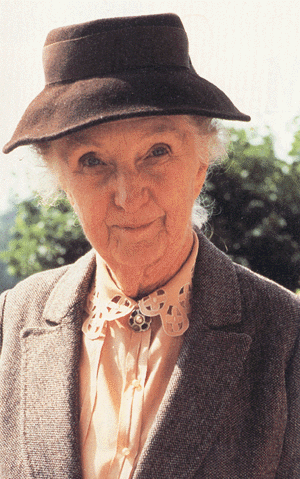
Now: to be clear, this is not actually my Granny. This is Miss Marple. However, I am confident that Miss Marple would have pretty much the same opinions on stuff as my Granny would, with a bit of sleuthery thrown in just for fun, and using this picture means I don't have to violate my actual Granny's privacy against her will. "Hey Granny, would you mind if I use a picture of you to illustrate a post about your attitudes to life on my blog on which I discuss things like BDSM and kyriarchy and how the world would be so much better if women had sex like cats?"

So! The rules of the game are pretty simple. First, you formulate your Intractable Life Dilemma, preferably in the most high-falutin modern fancy talk you can manage. Then, you imagine Miss Marple and/or my Granny making the facial expression pictured above, while saying, "blust, ha' you gone soft?"

For the remainder of the game I will be translating GrannySpeak into high-falutin modern fancy talk, with more swear words, to avoid charges of taking the piss out of people from Norfolk.

ROUND ONE: LOVE LIFE
"Granny, I am in a quandry," I say, approximately once a year since the age of 15, in my mind. "Relationships are HARD. What dating situation would be most beneficial to my mental health? Is it possible to maintain desire and affection indefinitely in a long-term, monogamous relationship, and if so, how? Am I defective if I can't do so?"

Imaginary Granny response:
"Are you fucking nuts?" responds imaginary Granny, side-stepping the fact that I am, in fact, fucking nuts, because she doesn't know this. Every time I visit her and have a daytime nap or display some other exciting symptom of depression, she takes my dad aside and asks him Extremely Discreetly, "Is Hannah pregnant?" NO. STILL NO, GRANNY.

Anyway, back to Love Advice. "Are you fucking nuts? You want relationships to be fulfilling? You think being single might be better than being married? WHAT FRESH HELL IS THIS? Of course you're going to get married, to the first person who offers and who you don't hate. You're worried about still fancying your paramour in ten years? It doesn't matter whether you fancy him at all! Women don't enjoy sex, not really, but you'll put up with it, because it's your duty, and because you want children."

ROUND TWO: WORK LIFE
"Granny, my job is B-O-R-I-N-G, for real. I'm stuck in this admin basement where I'm spectacularly underemployed, I can get through my work in about one day a week and I spend the other four desperately looking for something, anything, to keep me occupied; I want to do something more interesting, but I have no idea what - should I be an accountant? A solicitor? A writer? A mental health nurse? Should I move to Madagascar and devote my life to saving lemurs? Or move to Dorset and farm llamas? Should my career be Being Lemar? Or Mark Lamarr? I hope not the latter! How do you know what it is you want to do with your life? What if I spend the next thirty years in an agony of indecision and wasted potential and never amount to anything and never get to go HA, all those miserable years getting picked on at school were so worth it because now I have a fantastic career and have therefore WON? Or what if I do make a decision, but it's the WRONG decision? WHAT THEN, IMAGINARY GRANNY? WHAT THEN??"

She makes this face again.


This face combines derision, bewilderment, and barely-kept-in-check hysterical laughter.

"Are you actually serious?" asks Imaginary Granny. "You want work to be fun? Stimulating? Personally fulfilling? It's WORK, you idiot, not a fucking voyage of self-discovery. Does your work run the risk of giving you cancer from breathing asbestos dust in all day? Does it leave you screaming with pain from twelve hours straight bending over in the strawberry fields (and don't you dare sing that rubbish hippie song at me)? Has anyone you work with ever got hypothermia from working an illegal double shift in cold storage? No? THEN WHAT THE FLYING FUCK ARE YOU WHINING ABOUT? Also you should keep chickens. Free eggs!"

Now, this game can be dangerous. It is not for the faint of heart, or the unstable of mind (WHOOPS). It is also not very useful in actually solving those Life Dilemmas, because "in the 1930s people of the rural working class didn't expect marriage to meet their every emotional and sexual need, had substantially lower expectations re: said needs, and did whatever work would feed their families without expecting it to blow their minds" is not particularly good life advice: it is, rather, a very short history essay.

I do, however, find it refreshing, in moderation. It is a healthy reminder of the unimaginable social progress we've made over the course of the 20th century, and of how grateful we should be to have these choices. Plus, a gentle nudge not to get so desperately fixated on your own middle class white lady problems is always to the good.


Tuesday, 25 February 2014

A History Lesson: women work.

If I read one more article claiming that women didn't work before the fifties I'm going to beat said article upside the head with my history degree.

Shit, was that classist? Okay. I'm going to beat it round the head with my ABILITY TO READ FUCKING WIKIPEDIA.

"What was the most important technological invention of the last four hundred years?" asked the lecturer, back in English Social History 1851-1991. "The spinning jenny!" said one dude, who was very into Marxism and the Industrial Revolution. "The internet!" piped up another, who clearly had his own website on Geocities back in the 90s and was so proud of himself for thinking outside the box.

"Would any women like to make a suggestion?", Mr Lecturer asked. I grinned. I was going to like this class.

"The pill?" I proffered. "Or the washing machine?"

Southampton City Council paid a giddy fortune for me to get educamacated, and I took on a hefty wallop of debt for the same reason, and from my perspective, it was all worth it just for that one moment in a cramped, musty corner of a converted Georgian townhouse. We beamed at each other in a smug haze of humanities joy, silently congratulating each other on being at least six times cleverer than anyone else in the room. It was ace.

So yeah, the washing machine probably had more impact on society than the internet. But saying things like
"Rather than spend their time washing clothes, women could go out and do more productive things. Basically, it has doubled the workforce."
displays not only a racist, classist conception of "women" as a category, but also a basic lack of appreciation of actual historical facts. When people say "women" didn't work before the fifties (or 1939, or 1914, or whatever arbitrary date you're throwing at me) they mean middle class white women didn't work.

Poor women, which, then even more than now, included virtually all women of colour, have always had to work. It wasn't a choice between sitting at home in a Feminine Mystique nembutal haze or throwing off domestic shackles to take up a fulfilling career in advertising or whatever - it was a choice between shitty, back-breaking, poorly paid work, or your kids not eating.

Rather than spend their time washing clothes... do you really think that middle-class and aristocratic white women scrubbed their own knickers? Come on. They hired poor women to do it for them, as well as light their fires, swab their floors, cook their meals and raise their kids. Hundreds of thousands of working class women made their living this way - before and after marriage - because there was no other option.

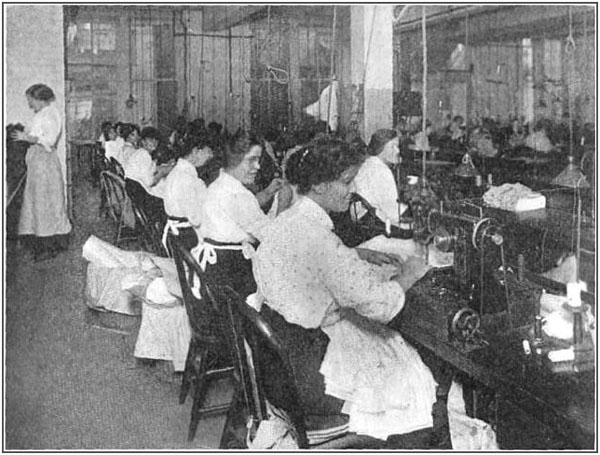
Let me take you on a whistlestop tour of female engagement in the British workforce. Back in ye olde medieval times, they worked on the land; with the rise of cottage industry, the home and the workplace were one and the same, and women worked as weavers and candle makers and cobblers and locksmiths and in dozens of other trades. Women dominated the factory workforce during the early years of the Industrial Revolution. Up until the Second World War, women also made up the bulk of domestic workers, before inventions like the washing machine - oh hi! - radically reduced the availability of jobs in this area. Even before this, more women chose factory work when it was available (particularly in war time) due to the greater freedoms and higher wages it offered. Particularly from turn of the 20th century, women also worked in shops, as secretaries, as waitresses.

Obviously they were mostly forced into the more menial, lower paid end of every industry, and paid less than men for identical work, because sexism. Bit like today, really.

Oh yeah, and you'd better clarify that you're talking about work outside the home, or are you saying that raising kids and scrubbing floors and feeding families and growing food and making clothes and washing huge tracts of fabric by hand only counts as work if someone's willing to pay you a pittance for it? Really?

What people really mean when they talk about Women Working Outside The Home is women getting fancy white collar professional work - fields like law and medicine which didn't open up to women as a class until much later. (For more on how traditionally female fields of healing and midwifery were taken over by the chaps, who, centuries later, deigned to let the ladies back into 'their' field, try Barbara Ehrenreich's For Her Own Good.)

Claiming that women as a class didn't work before some kindly gentleman rocked up to liberate them with his exciting new labour-saving washing machine is to ignore vast swathes of historical reality. It reduces the millions of women who were active in the workforce, and in the trade union movement, to footnotes in the important business of Dude History. And it's just not true.

Wednesday, 19 February 2014

we're exactly what this country needs

Four conversations:

1. Is monogamy a problem, and, if so, what is the solution? Is it creepy 70s style swinger parties where you'll inevitably end up face to face with your dad?

2. Compare and contrast the popular and media reactions to John Terry calling an opposition player a "black cunt", and Luis Suárez calling an opposition player "negrito". The former remains England's Brave JT, beloved in his besieged, boring stolidity; the latter decried as a latter day demon, the diving, cheating, out-of-control biting little fucker. a) Racism? Racism. b) How much does this depend on applying West European/USian colonial conceptions of race and integration, wherein we're all supposed to pretend to be Colourblind and treat the fact that some people aren't white as a secret that dare not speak its name, to a South American context? c) How much of our attitudes to the issue is based on i) the fact that we support Liverpool, and ii) this video?


3. If class expresses itself in part in terms of attitudes, beliefs, and ways of living, and most people retain those attributes when they change their material circumstances (eg. someone from a working class family earning over £30k and meeting world leaders on a semi-regular basis still finding that expensive dinners and posh hotels feel exclusionary; or someone born into the monied middle classes living out the Common People lifestyle but still feeling that expensive dinners and posh hotels are a human right), is it still meaningful to describe individuals as being working- or middle-class? Is class something better understood on a macro level (while still acknowledging the micro effects on people's daily lives), with individuals' migration between classes basically irrelevant on a larger scale?

4. On difficult conversations:
"Dude, you just need to suck it up and talk about it. Get over your natural British reserve about discussing difficult subjects."
"I think it's a female thing too, the imperative to say whatever will make the most people the most comfortable, rather than what is actually true? Social lubrication, emotional drudge work, that sort of thing."
"Sure, but that's a very class- and nationality-specific version of femaleness though isn't it? Like, I'm not going to trot out the stereotypes, but not all women in the world are socialised into the nicey nice kind of womanhood you're talking about."

On the one hand: I have really good friends. Yay for us.

On the other: if we can do this in normal conversation, poking and prodding at our respective privileges and working through difficult ideas together, utilising our differences in terms of class and race and sexuality and gender rather than getting pummeled by them - over email when we're bored at work; on the phone while we're cooking dinner; on the sofa with the Champions' League on in the background - why is it so difficult for feminism, and social justice movements in general, to do this on a bigger scale? I suppose I'm back at the eternal question of Why Does Feminism Keep Fucking Up, a post which, hilariously, has no comments.

Friday, 14 February 2014

Ruddy bloody brave strikes again

Because I am a tireless warrior against the heterosexist patriarchal implications of Valentine's Day, I spent the first three hours of February 14th in the Whittington Hospital having my heart function monitored.

For romance.


In sadly less hilarious news, the ECG tech was the worst. I go for tests so often that we've kind of bonded - we greet each other by name, I ask after her kids, she compliments me on my boots, I forget that I'm semi naked in a seriously cold room.

Sadly, a shared love of charity shops does not preclude someone being an intrusive, overstepping, disableist fuckwit.

The referral form said "high resting heart rate noted after switching anti-depressants, please check for recurrence of ablated tissue".

The ECG tech said, "You don't need to be on anti-depressants! You just need to be brave!"

I could have said, "well, I've been exhausted since 2009, I feel like I'm walking through a thick, viscous fog most days, I have been trying really hard not to kill myself or lacerate my long-suffering left arm since last May, and the only thing that has had any noticeable impact over the last eleven fucking years is the combination of mirtazapine and venlafaxine which are upping my serotonin and noradrenalin and making being awake feel like an achieveable possibility, and no, "being brave" is actually not as effective at that."

I could have said, "when you do ECGs on patients who take insulin to manage diabetes, or beta blockers to address cardiac arhythmia, do you tell them that they should ditch their meds and just 'be brave'? When you have a headache, do you take a paracetamol, or do you just tell yourself to 'be brave'?"

But, y'know, fuck it. I made a split second decision that, if she was going to say something so cruel and make me feel so uncomfortable, I would, for a moment, drop the constant effort to make unmad people feel comfortable when faced with mental illness. I would make her as uncomfortable as she made me.

I said, "Well, I want to die, so I think I kind of do."

Not to brag, but I think my response was actually pretty brave.

Thursday, 13 February 2014

Valentine's and Galentine's, Steaks, Fisting and Falafel

The only thing I find more depressing than Valentine's Day, in a world-weary is-this-really-how-people-see-themselves why-god-why sort of way, is Steak and Blow Job Day.

They're two sides of the same tired, heterosexist, high fives to the patriarchy coin: predicated on the assumption that
1. Men like sex but hate relationships, and
2. Women like relationships but hate sex.

It's such an unbearably sad way of looking at romantic interaction. If you genuinely believe both of those things, wouldn't any dude-lady relationship be an unfulfilling transaction where you tolerate something you dislike in order to get something from another - something they don't want to give? Why would you want to fuck someone who doesn't want to be fucking you? Why would you want to date someone who wasn't thrilled to be dating you right back?

It reminds me of Cliff Pervocracy's point about Fifty Shades of Grey: that negotiation is about finding ways for both partners to have a mind-blowingly amazing time - not about one party presenting a list of all the things they want to do to their partner and said partner picking the ones she hates least.
I asked for it, and I could have stopped it without fear of retaliation.  My tops asked me--and gave me--what I wanted, not merely what I could tolerate.  The whole thing was full of a spirit of fun and experimentation, not anger or bitterness.  And I loved the hell out of it.  I didn't come away thinking "that wasn't so bad" or "I had that coming." I came away thinking "I feel fucking fantastic." From Let's Read Fifty Shades of Grey: Chapter 15!
Of course, what's really frightening about this assumption is that it describes all sex as something that women will put up with but fundamentally don't want. It elides all sex with rape. Some radical feminists take this approach and argue that all PIV sex is bad because it's like rape; misogynists can convince themselves that rape isn't that bad because it's just like sex but more so. Neither approach leaves any room for female pleasure.

So imagine what a blessed relief it was to find out that someone has invented Fisting and Falafel Day.

I don't even really like falafel.

...

What I actually wanted to talk about, before I got distracted by rape culture (happens to me all the time), was Galentine's Day.


I celebrated it for the first time last year, because my Beloved Lady Friend was sad, and I thought she might be sad about being single on That Day, so we went for a pint and talked about novel writing and rimming and mental illness, because that's how we roll. This year, there will be two Beloved Lady Friends, and cocktails, and it will probably be exactly like Sex & The City, except in grimy north London. By next year I anticipate reaching Knopelike levels of dedication with knitted cushions featuring intarsia designs of my friends' faces embroidered with inspiring quotes from Eleanor Roosevelt.

The other half of my objections to V-Day - if you love your partner so damn much, show it every day of the year; why do you need a special day to remind you to be nice to them? - can easily be applied to G-Day. I suppose the difference is, with the former, it feels like you're Being Told to participate, whereas the latter is an active choice. Plus, our culture never stops trumpeting the Enormous Power of Romantic Love - but taking time out to celebrate the joys of female friendship feels a tiny bit subversive.

I'm going to end this here before I start extolling the virtues of abjuring electric light in favour of aligning your cycle with that of the moon. Happy Galentine's.